Marketplace Fees Are Climbing Fast: Is It Time for Vietnamese Businesses to Own Their Website?
BrandKDN TEAM10 min read
Market snapshot: platform fees hit a new high in 2026
Starting in May 2026, Vietnam's three largest e-commerce platforms — Shopee, TikTok Shop, and Lazada — simultaneously raised multiple fee categories, with increases of roughly 2–4% depending on product category. Shopee alone raised its transaction processing fee for prepaid payment methods from about 4.9% to 6%, while also adjusting its fixed fee by category to 8.8–11.7% for regular sellers and 2–10%+ for Shopee Mall stores. TikTok Shop likewise increased commission fees across most categories, with fashion, health & beauty, and mother & baby products seeing the steepest hikes.
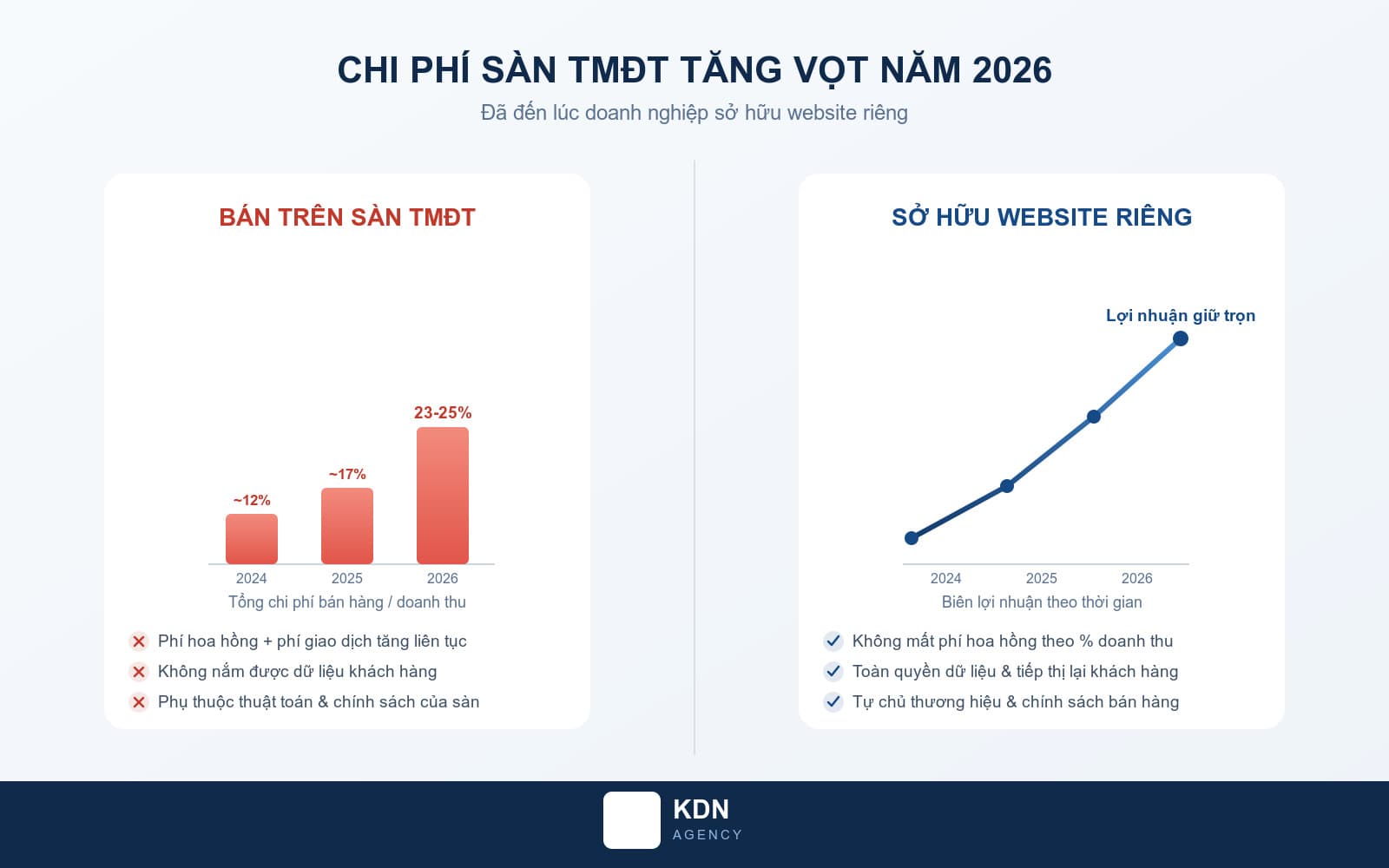
As a result, total selling costs on these platforms — combining transaction fees, fixed fees, and commissions — now reach 23–25% of revenue, before even counting advertising, operations, or affiliate marketing costs. When all of these are added together, some sellers report total costs climbing as high as 40–45% of revenue. Notably, Shopee and TikTok Shop together now control nearly 98% of Vietnam's retail e-commerce market share, leaving most sellers with little real alternative but to accept whatever terms the platforms set. Facing pushback from the seller community, Vietnam's E-commerce and Digital Economy Agency (under the Ministry of Industry and Trade) said it is closely monitoring the fee increases and has asked platforms to review their fee policies to make them more transparent, reasonable, and rolled out with an appropriate transition period. That said, this remains a recommendation rather than a binding regulation — meaning the risk of further fee hikes down the road is still very real.
Why this matters for sellers
When platform costs rise faster than revenue, sellers' profit margins get squeezed relentlessly. Many shop owners report that orders that once looked profitable now leave only a few cents of margin — or break even entirely — once every fee is deducted. Because price competition on these platforms is fierce (a price just slightly higher than a competitor's can send a customer to another storefront in seconds), sellers can rarely pass the full cost increase on to buyers without losing sales. The pressure lands squarely on their own margins, and over time it risks pushing prices up for consumers as well. The core issue is dependency: when nearly all of a business's revenue flows through one or two platforms, that business has almost no leverage to negotiate fee policy, ranking algorithms, or protection against sudden account suspensions caused by technical glitches or unintentional policy violations.
Owning a website: a solution to the dependency problem
Against this backdrop, more businesses are seriously considering building their own e-commerce website — not to abandon marketplaces entirely, but as a parallel sales channel that balances out the risk.
Lower costs, higher margins. Instead of handing over 20–25% of revenue (or more) in marketplace fees, a business with its own website mainly pays fixed operating costs — hosting, domain, and payment processing — which are typically far lower than a percentage-of-revenue commission. Businesses also don't need to inflate prices just to offset marketplace fees, which helps them stay competitive on price.
Full ownership of customer data. On marketplaces, direct customer contact information is often restricted or hidden, forcing sellers to keep paying for on-platform ads just to reach their own repeat customers. With an owned website, a business retains phone numbers, emails, and purchase history — the foundation for email marketing, loyalty programs, and remarketing at a fraction of marketplace ad costs.
Building an independent brand. On a marketplace, a product always sits next to dozens of competing listings, making it easy for shoppers to compare prices and switch to a rival with a single tap. An owned website gives a business full control over its design, brand story, and shopping experience, free from competing product suggestions diluting its positioning.
Reduced policy risk. Fee changes, algorithm shifts, or even account suspensions are largely outside a seller's control on a marketplace. With an owned website, a business sets its own sales rules and return policies and isn't caught off guard every time a platform "updates its policy."
Not either/or — a combined strategy
In practice, the optimal strategy for most businesses isn't abandoning marketplaces altogether — they still deliver significant traffic and orders thanks to platform-level reach — but building an owned website alongside them as a "home base." Marketplaces can continue serving as a channel for reaching new customers, while the owned website becomes the place to retain repeat customers, build the brand, and protect long-term margins. With platform fees likely to keep climbing as two dominant players hold near-monopoly market share, owning an independent sales channel is shifting from a "nice to have" to something closer to a business necessity for protecting profitability and long-term operational independence.
Sources: VOV, Tiền Phong, CafeF, Người Lao Động, VietnamFinance, VietBao, Vietstock (Vietnamese news coverage from May 2026 on rising e-commerce platform fees in Vietnam).